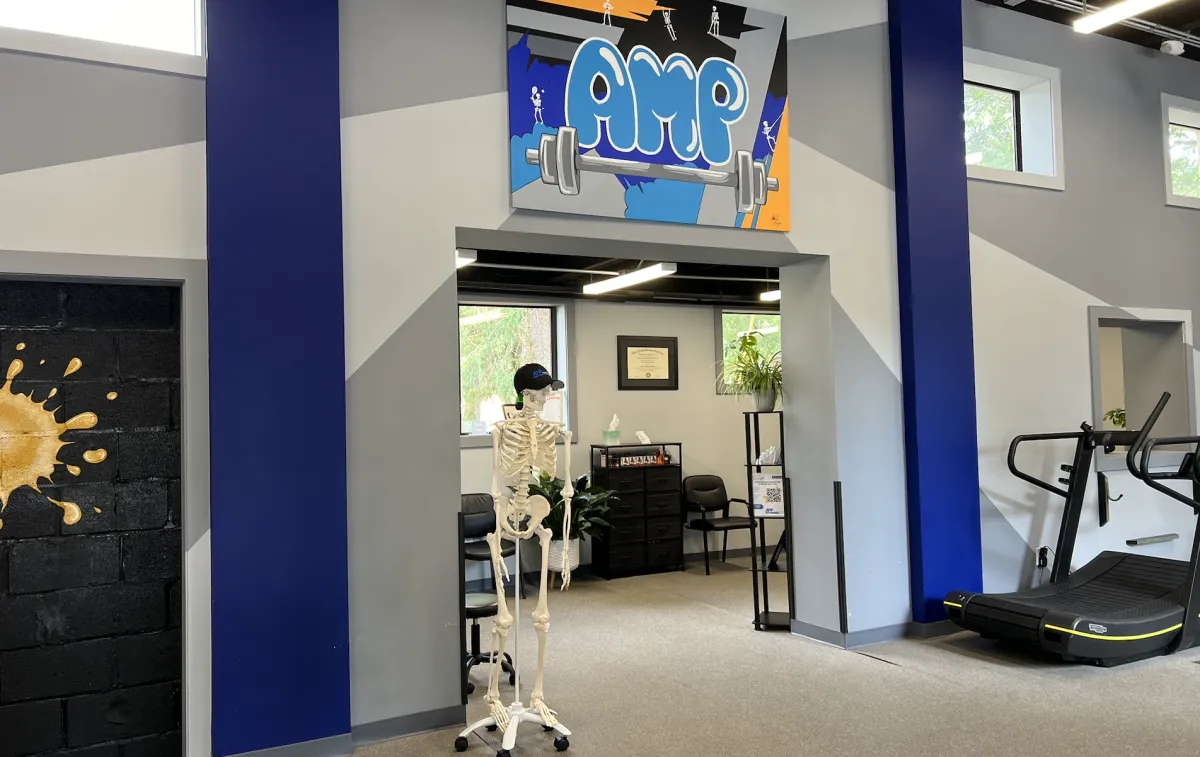
Sciatica That Won't Go Away? | Chester, NJ Physical Therapy
"I don't know if it's sciatica at this point."
"Is this just something I'm gonna have to deal with because of my herniated disc?"
We hear versions of these lines on calls every week at AMP Performance Rehab in Chester, NJ. The pain starts in the low back or glute, then shows up down the leg. Some days it's a dull ache in the butt. Other days it's burning, tingling or numbness all the way into the foot. You stop sitting through dinner. You skip the gym because you don't know what will set it off.
If that sounds familiar, here's the honest answer to the question most people are really asking: will it go away, and what actually helps?
What Sciatica Actually Is
Sciatica isn't a diagnosis. It's a description. It means something is irritating the sciatic nerve or the nerve roots in your low back that feed it. The result is pain, tingling, numbness or weakness that travels from the back or glute down the leg.
A few things can cause that irritation:
- A disc that's bulging or herniated and pressing on a nerve root
- Stiffness or narrowing in the low back that leaves the nerve less room
- Tight, overworked muscles around the hip and glute
- A back that's carrying load the rest of your body stopped sharing
That last one is the piece most people never hear about. Your hips, mid-back and legs are supposed to share the work when you sit, bend, lift and run. When one of them stops doing its job, the low back picks up the slack. Over time, the nerves in that area get cranky.
Will Sciatica Go Away on Its Own?
Sometimes, yes. Plenty of first-time flare-ups calm down over a few weeks.
But "calmed down" and "fixed" aren't the same thing. If the reason the nerve got irritated is still there, the pain often comes back. Usually at the worst time: the week of a race, a long drive, a trip with your family.
That's why so many people tell us some version of: "It went away last year, and now it's back worse." The flare faded. The cause didn't.
Why Rest, Stretching and Generic Exercises Often Don't Hold
Most people with sciatica have already tried the usual list:
- Rest. It can help a flare settle. But weeks of doing less leave your back and hips weaker, which makes the next flare more likely.
- Stretching. Pulling hard on an irritated nerve can make it angrier. Some of the most popular "sciatica stretches" online do exactly that.
- Injections and pills. They can quiet the pain for a while. They don't change how your body moves or loads your back.
- Generic PT. We often hear, "Physical therapy didn't really help. I think it made it worse." When the plan is a sheet of exercises that ignores where the irritation is coming from, that's not surprising.
None of these are bad on their own. The problem is guessing. The right exercise at the wrong time can keep the nerve irritated. The wrong exercise at any time can set you back weeks.
What Actually Helps Sciatica
Real, lasting sciatica pain relief usually follows three steps.
1. Find what's irritating the nerve. This means testing more than your back. How do your hips move? Does your mid-back rotate? Which positions bring on the leg symptoms, and which ones ease them? Is one leg weaker than the other? The answers tell you what's driving the pain.
2. Calm things down without shutting down. Most people do better staying active in the right way than resting completely. That might mean changing how you sit and sleep for a while, finding positions that take pressure off the nerve, and doing gentle movement that settles symptoms instead of stirring them up.
3. Rebuild so it stays fixed. Once the leg symptoms settle, the real work starts. Restoring motion in the hips and mid-back. Strengthening your trunk, glutes and legs. Then loading back toward what you care about, whether that's deadlifts, long runs, golf or a two-hour drive to the shore.
At AMP, that's exactly how we work. It starts with AMP's Root Cause Assessment: 60 minutes, one on one with a Doctor of Physical Therapy, looking at your whole body, not just the spot that hurts. From there, the plan moves through Recover, Rebuild and Redefine, and we re-test every session so you can see whether you're making progress. You can read more about how we approach it on our sciatica physical therapy page.
When to Get Help (and When to Go Straight to a Doctor)
Go to the ER or call your doctor the same day if you have any of these:
- Numbness in the groin, inner thighs or "saddle" area
- New trouble controlling your bladder or bowels
- Leg weakness that's getting worse quickly, or your foot starts to drag
- Sciatica after a major fall or accident, or with fever and feeling unwell
These are rare, but they need medical attention right away.
For everything else, it's time to get a professional opinion if:
- Leg symptoms haven't improved after 2 to 3 weeks
- This is your second or third flare
- You're avoiding sitting, driving, sleeping on one side or training
- You've tried rest, stretching or a round of PT and it didn't hold
The longer sciatica hangs around, the more your body works around it, and the harder it gets to undo. Many people we see in Chester, NJ waited months longer than they needed to.
Not sure if what you're feeling is sciatica? Book a free discovery call with our team. Tell us what's going on, and we'll tell you honestly whether we think we can help.
Sciatica FAQ
Do I need an MRI before physical therapy for sciatica? Usually not. Many people without any pain have disc bulges on an MRI, so the image alone doesn't explain your symptoms. A thorough movement assessment often tells you more about what to do next. If your symptoms point to something that needs imaging, we'll tell you and coordinate with your doctor. In New Jersey you can also start PT without a prescription (here's how that works).
What's the best sleeping position for sciatica? Many people do well on their back with a pillow under their knees, or on their side with a pillow between their knees. The best position is the one that eases your leg symptoms, which is one more reason to know what's irritating the nerve.
Should I keep working out with sciatica? Often, yes, with changes. Full rest usually isn't the answer. But pushing through heavy lifts or long runs that light up your leg is a recipe for a longer flare. The goal is to find what you can do while the nerve settles, then build back up.
How long does it take to get better? It depends on how long you've had it, what's driving it and your goals. Some people feel a change in the first few visits. Building back to full training takes longer. We'd rather give you an honest timeline than a quick promise.
Do you see patients from outside Chester? Yes. Patients come to us from Far Hills, Bernardsville, Basking Ridge, Peapack-Gladstone and Bedminster, among other towns.
Stop Planning Your Life Around Your Leg
Sciatica doesn't have to be something you just deal with. If you want to know what's actually irritating the nerve and get a clear plan to fix it, schedule your free discovery call. It's a short call with our team, no pressure, and you'll walk away knowing your next step.
